News
- Meeting Held at Baku Business University
- Knowledge Day Event Held at Baku Business University
- Baku Business University Announces Admission to Vacant Master’s Degree Places
- Attention Students Admitted to Baku Business University!
- Attention Students Admitted to Baku Business University!
- Üfüq Student Residence is at your service to make student life more comfortable and convenient.
- August 12 – International Youth Day!
- Attention Doctoral Students and Young Researchers!
- Baku Business University Successfully Participated in the Higher Education Institutions Fair Organized by the State Examination Center
- Scientific Seminar Dedicated to the Independence Day of the Republic of Azerbaijan Held in Budapest
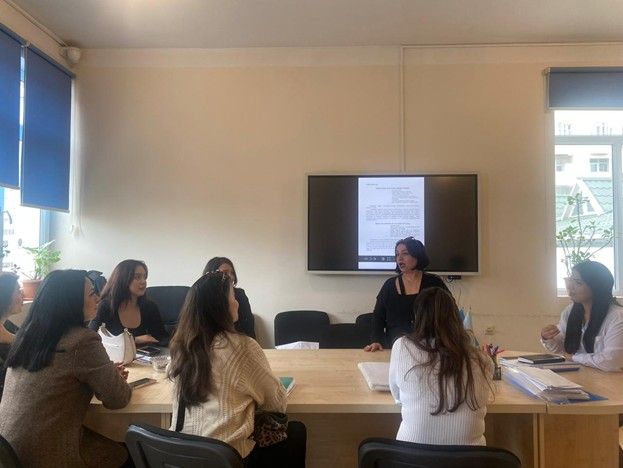
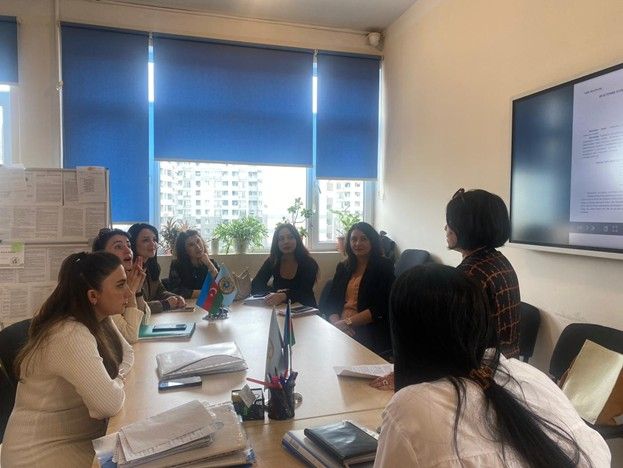
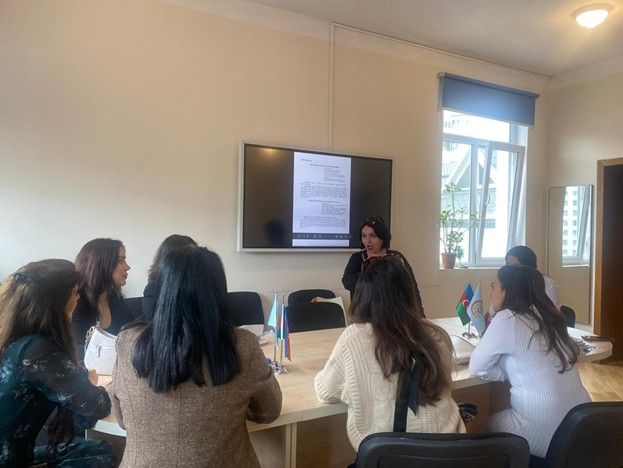
Roundtable on “Modern Urban Planning and Architecture: Scientific Approaches and Challenges” Held at Baku Business University

On April 10, 2026, a roundtable discussion titled “Modern Urban Planning and Architecture: Scientific Approaches and Challenges” was held at Baku Business University, organized by the Department of Humanities.
The purpose of the event was to discuss existing scientific approaches in the field of modern urban planning and architecture, analyze urban development trends, and increase attention to current challenges in this area.
Within the framework of the roundtable, Professor Nigar Akhundova, PhD in Technical Sciences Nasimi Rzayev, Ganira Mirzaxanli, and PhD in Technical Sciences Aygun Kamandari delivered presentations and shared their views on the development directions of modern urban planning, scientific approaches, and existing challenges.
The speakers noted that modern urban planning is not limited only to the planning of physical spaces, but is also a multidisciplinary field requiring the comprehensive consideration of social, economic, and environmental factors. It was emphasized that issues such as population density caused by rapid urbanization, traffic congestion, ecological imbalance, and infrastructure deficiencies are among the major challenges facing contemporary urban planning.
In her speech, Professor Nigar Akhundova highlighted the importance of applying scientifically grounded planning methods, as well as integrating digital technologies and Geographic Information Systems (GIS) into urban planning processes in order to address these challenges. She noted that the “smart city” concept is one of the promising development directions of modern architecture and urban planning, enabling more efficient management of resources.
At the same time, special emphasis was placed on the importance of combining aesthetic and functional approaches in architecture, as well as preserving national architectural traditions in shaping the urban environment. It was noted that maintaining local architectural identity under globalization conditions increases the cultural value and uniqueness of cities.
In conclusion, the speakers stressed the importance of strengthening the role of scientific research in solving modern urban planning problems, developing university–practice cooperation, and more actively involving young specialists in this field.